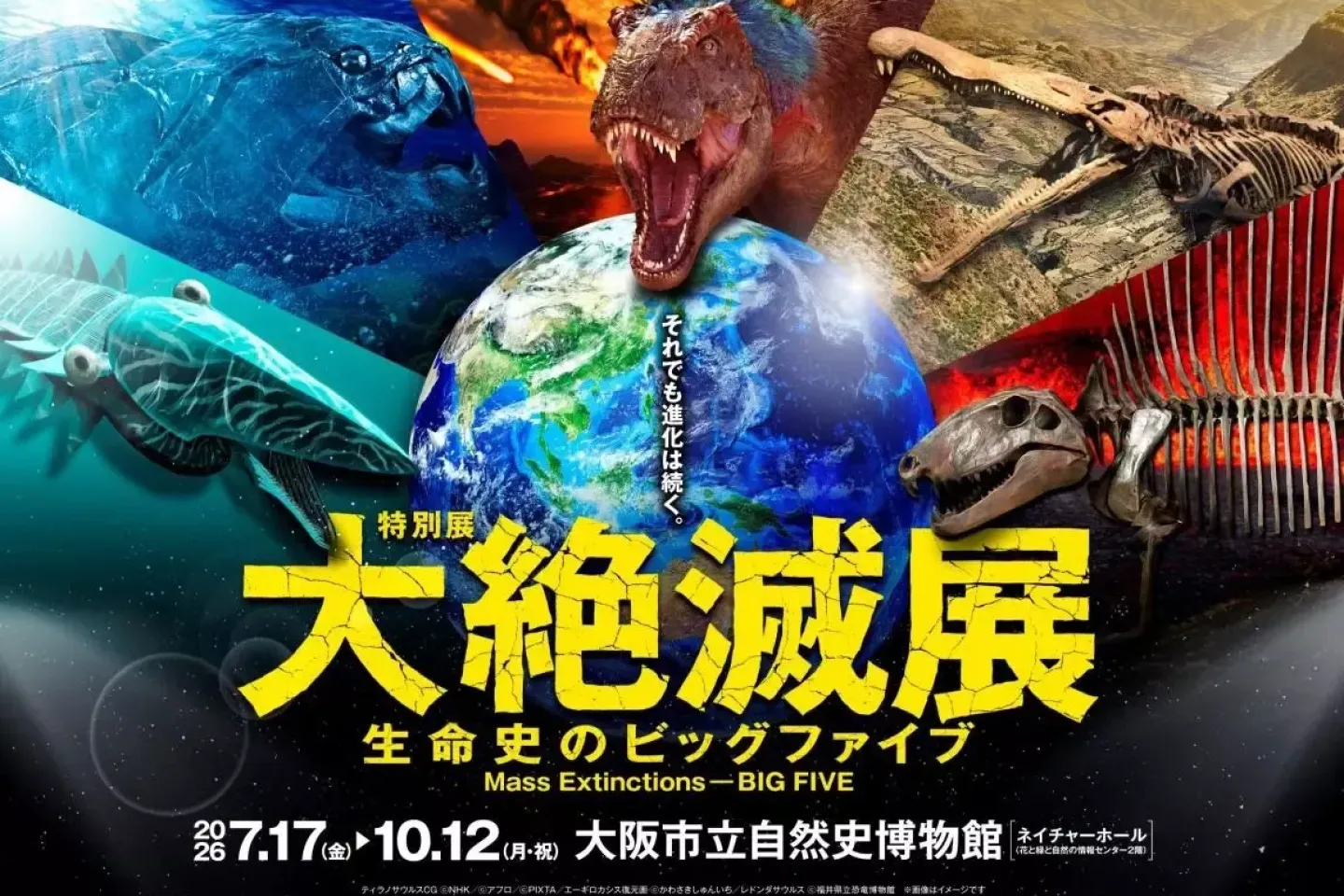

The idea of extinction has always held a strange pull over human imagination. Perhaps it's because it forces us to confront impermanence on a planetary scale, or because each ending hints at a reset that reshapes the future. From dinosaurs to distant marine life wiped out hundreds of millions of years ago, extinction stories sit at the intersection of fear, curiosity, and wonder. That enduring fascination is at the heart of a major upcoming exhibition in Osaka.
From July 17th to October 12th, 2026, the Osaka Museum of Natural History will host a special exhibition titled Mass Extinctions – The Big Five. As the name suggests, the exhibition explores the five largest mass extinctions Earth has experienced over the past four billion years, moments when more than 75 percent of species disappeared in a geological blink of an eye.
Rather than focusing solely on catastrophe, the exhibition frames mass extinctions as pivotal turning points that ultimately reshaped life on Earth. Through fossils, rock evidence, and the latest research, visitors can trace how life repeatedly collapsed, adapted, and re-emerged in new and unexpected forms. Highlights include rare specimens connected to the end-Ordovician extinction, the giant armored fish Dunkleosteus from the Devonian period, and volcanic activity linked to the end-Triassic event. Some materials on display will be shown in Japan for the first time.
Supervised by leading researchers from the National Museum of Nature and Science, the exhibition promises both scientific depth and visual impact.
Getting there
The Osaka City Museum of Natural History is located approximately 8 minutes on foot from Nagai Station, which is served by the JR Hanwa Line and the Osaka Metro Midosuji Line.
/135.522472,34.6103141,9/397x132?access_token=pk.eyJ1IjoiamFwYW50cmF2ZWxtYXBzIiwiYSI6ImNqbXBtOXYxbDB5Z3ozbHFrazJuYWMwOGYifQ.v15fy_mcFWtgopmz8PhwqA)